

Exploding Rocket Sparks Uncertainty Over NASA’s Lunar Ambitions
- Blue Origin’s New Glenn rocket explosion raises doubts about its ability to meet lunar commitments.
- NASA’s plans for a Moon base are now potentially delayed, complicating a competitive landscape against China.
- Amazon’s satellite rollout faces significant challenges with LEO broadband network after the incident.
A Shocking Incident at Kennedy Space Center
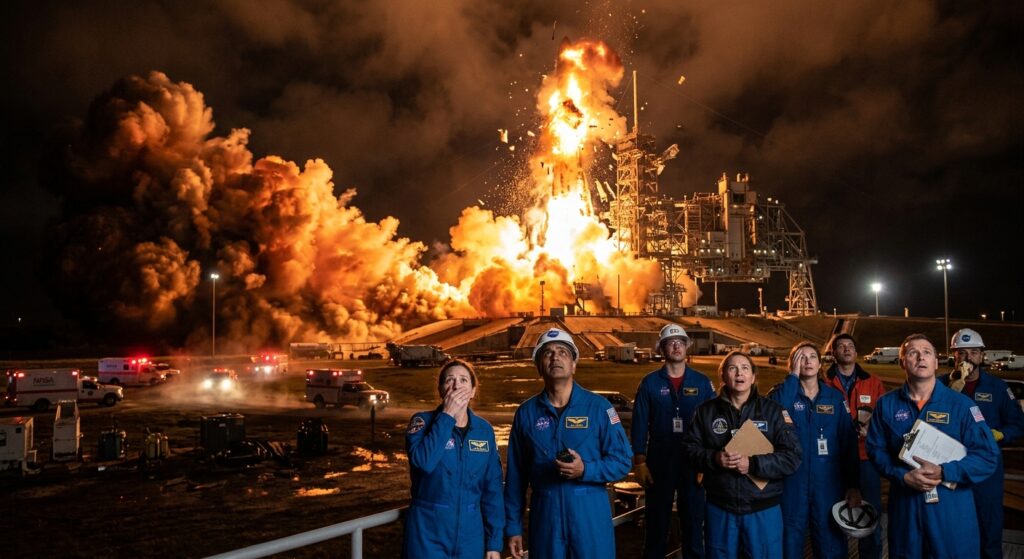
On a dramatic evening in Florida, the Kennedy Space Center became the backdrop for an unexpected crisis as Blue Origin’s New Glenn rocket erupted in a fireball during a routine engine test. The incident occurred around 21:00 local time, raising immediate questions about the company’s capabilities to fulfill its commitments to NASA for upcoming lunar missions. As Blue Origin grapples with the aftermath, the implications stretch beyond corporate obligations, affecting national ambitions for lunar exploration.
Blue Origin had plans for its New Glenn rocket to launch a constellation of satellites for Amazon’s Leo broadband network—a mission yet unrealized due to previous delays. With no injuries reported, founder Jeff Bezos remained optimistic, stating on social media that his team would rebuild and continue their efforts. Nonetheless, the explosion has rendered Space Launch Complex 36—the sole launch facility for the New Glenn—unsalvageable for the near future, leading to extensive delays anticipated to last months.
The Ripple Effect of Setbacks
Blue Origin’s explosion comes on the heels of NASA Administrator Jared Isaacman’s recent announcement concerning the agency’s ambitious plans to establish a permanent presence at the Moon’s south pole. The initial mission, Moon Base 1, slated for launch as early as autumn 2026, relied on the Blue Moon Mark 1 lander, once set to be launched by the New Glenn rocket. This new setback has put into doubt the feasibility of that timeline and has broader implications for NASA’s future lunar objectives.
Further complicating matters, NASA recently awarded Blue Origin a significant contract valued at $468 million for lunar terrain vehicles to be deployed by 2028. This timeline, too, is now in jeopardy, as the agency aims for a crewed landing on the Moon. With only a fraction of the required satellites for the Leo network currently in orbit, Blue Origin will now have to count on its competitors, mainly SpaceX, to prevent even more delays.
The Road Ahead for NASA and Blue Origin
NASA’s Artemis III mission, part of its long-term strategy, is designed to prepare for a return of astronauts to the lunar surface. However, questions loom regarding Blue Origin’s readiness, given its setbacks following the rocket explosion. As the space race intensifies, particularly with China’s plans to land its astronauts on the Moon by 2030, NASA’s established timelines are increasingly uncertain.
Jared Isaacman’s comments about the unforgiving nature of spaceflight resonate in light of these events, urging a critical reevaluation of what’s ahead. The interdependencies of contracts and technology have never been more apparent, with a ripple effect that may impact not only the timeline of NASA’s lunar ambitions but also international competitive dynamics in space exploration.
In conclusion, the explosion of Blue Origin’s New Glenn rocket has introduced significant obstacles in both commercial satellite deployment and NASA’s lunar journey. As stakeholders anticipate the necessary recovery period, questions emerge: How will Blue Origin adapt to these challenges? What are the implications for NASA’s lunar objectives with rising competition from other nations? And ultimately, can the collective vision of a sustainable Moon base be saved from the current turmoil?
Editorial content by Reagan Chase